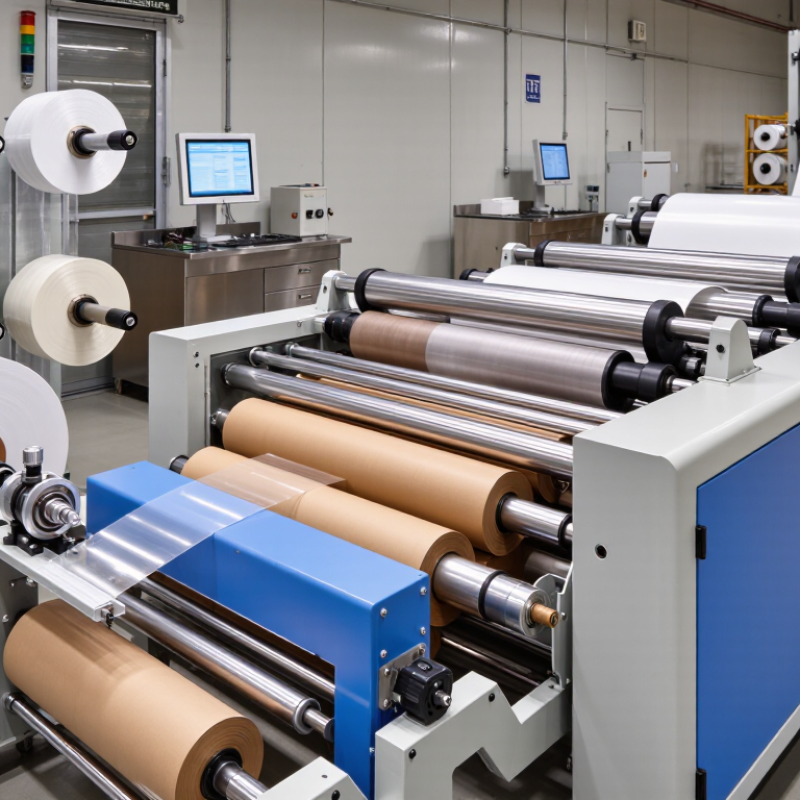
| Machine Function | Continuous web-to-web bonding | The machine joins two or more flexible webs into a composite structure. | The webs may be plastic films, paper, aluminum foil, nonwoven materials, or coated substrates. |
| Finished Structure Thickness | Approximately 12–250 μm | Soft laminates are generally thin, flexible, and suitable for bending, folding, or roll conversion. | The final thickness depends on the substrate thickness, adhesive coat weight, and number of layers. |
| Common Film Substrates | PE, PP, PET, PA, PVC, and EVOH-containing multilayer films | Different films contribute barrier, sealability, stiffness, printability, or puncture resistance. | Surface treatment may be required when the film has low surface energy. |
| Paper and Foil Webs | Paper, coated paper, aluminum foil, and metallized film | These materials can add print performance, opacity, light protection, oxygen barrier, or moisture barrier. | Foil handling requires careful tension control because thin foil can wrinkle or tear. |
| Typical Web Width | 300–1,600 mm | The usable width determines production capacity and the size of the finished rolls or pouches. | Actual width is selected according to the converting line, product format, and edge-trim requirements. |
| Unwinding System | Two or more roll stands with tension control | Each substrate is unwound and guided into the coating and nip sections at a controlled speed. | Dancer rolls, load cells, or servo-driven shafts are commonly used to stabilize web tension. |
| Lamination Speed | Approximately 50–300 m/min | Line speed determines output and affects adhesive drying, wetting, and bonding conditions. | Actual speed is limited by adhesive chemistry, web quality, coating method, and dryer capacity. |
| Adhesive Types | Solvent-based, solventless, water-based, or heat-activated adhesives | The adhesive forms the bonding layer between the flexible webs. | Solventless systems do not require solvent evaporation; solvent-based systems require drying and exhaust management. |
| Adhesive Coat Weight | Approximately 0.8–5.0 g/m² | Coat weight influences bond strength, appearance, flexibility, and material consumption. | The correct value depends on surface energy, adhesive type, substrate roughness, and end-use requirements. |
| Solventless Adhesive Application | Metering-roll or multi-roll coating | Two adhesive components are metered, mixed, and applied as a thin liquid film before entering the nip. | Accurate metering and temperature control are important because solventless adhesives are highly viscous. |
| Solvent-Based Adhesive Application | Gravure, reverse-gravure, or similar coating methods | The adhesive is applied to one web and dried before the coated web meets the second substrate. | The drying section must remove solvent vapors while preventing overheating or distortion of the web. |
| Nip Roller Function | Controlled pressure between rubber and steel or coated rollers | The nip removes air, improves wetting, and creates intimate contact between adhesive and substrate. | Excessive pressure can cause wrinkles, adhesive squeeze-out, or deformation of delicate films. |
| Nip Pressure | Typically 2–8 bar, depending on machine design | Pressure is adjusted to obtain uniform bonding without damaging the web. | Pressure should be verified across the web width rather than set only at one point. |
| Roll Temperature | Approximately 20–80 °C | Heated rolls can reduce adhesive viscosity, improve wetting, and support curing or bonding. | Temperature must remain below the thermal deformation or shrinkage limit of the substrate. |
| Drying Temperature | Approximately 40–120 °C for solvent or water removal | Hot-air dryers remove volatile components before the coated web reaches the laminating nip. | The required temperature depends on solvent type, water content, line speed, airflow, and coating weight. |
| Web Tension | Commonly 10–100 N per web, depending on width and material | Stable tension prevents wrinkles, telescoping rolls, registration errors, and uneven bonding. | Thin films generally require lower tension than paper or thicker, stiffer substrates. |
| Surface Treatment | Typically 38–52 dyn/cm for treated polyolefin films | Corona or plasma treatment increases surface energy and improves adhesive wetting. | Surface energy can decline during storage, so treatment level should be checked before production. |
| Curing or Maturation | Approximately 24–72 hours for many reactive systems | Some adhesives continue reacting after lamination until the required bond strength is reached. | Curing time varies with adhesive formulation, temperature, humidity, coat weight, and substrate combination. |
| Rewind Unit | Controlled-torque or differential-shaft rewinding | The laminated web is wound into a stable roll for curing, slitting, pouch making, or further conversion. | Rewind hardness must be controlled to avoid blocking, wrinkles, and roll deformation. |
| Primary Process Sequence | Unwind → treat or clean → coat adhesive → dry if required → laminate at nip → rewind | This sequence combines material handling, adhesive application, pressure bonding, and roll formation. | Some solventless lines omit the drying stage, while extrusion lamination uses a molten polymer layer instead of liquid adhesive. |
| Quality-Control Checks | Bond strength, appearance, thickness, coat weight, tension, and roll hardness | These checks confirm that the laminate has uniform bonding and is suitable for downstream processing. | Additional tests may include seal strength, oxygen transmission, water-vapor transmission, blocking, and heat resistance. |
| Common Defects | Wrinkles, bubbles, silvering, poor adhesion, curl, blocking, and telescoping | Defects can result from uneven tension, trapped air, incorrect coat weight, contamination, or unsuitable temperature. | Troubleshooting normally begins with web alignment, surface treatment, adhesive metering, nip pressure, and drying conditions. |
| Typical Applications | Flexible packaging, labels, medical packs, insulation, industrial films, and protective laminates | Soft laminates combine the properties of multiple thin materials in one flexible structure. | The selected structure depends on barrier requirements, sealing method, mechanical strength, printability, and regulatory needs. |