Industrial projects rarely fail because a material looks wrong on a drawing. They fail when weight, corrosion, installation, or maintenance needs are overlooked. A Frp Rectangular Tube can help address several of these demands. Made from fiber-reinforced polymer, it is lightweight and does not rust like conventional steel. That can matter on platforms, equipment frames, walkways, and supports exposed to moisture or certain chemicals. Less weight, simpler handling.
The profile’s flat faces can also make fastening and assembly more practical. Yet performance depends on the product, not the label alone. Fiber type, resin system, wall thickness, manufacturing quality, and connection design all affect how a tube behaves. Engineers should check load direction, span, deflection, temperature, and the site’s chemical exposure before specifying it. A supplier’s technical data is useful, but project conditions still need careful review.
There are trade-offs. FRP may not suit every high-temperature, impact-heavy, or tightly budgeted application. Drilling and fastening also need planning, since poorly designed connections can weaken a member. Even a durable profile needs sensible inspection. The choice is not automatic. It becomes convincing when its lower weight, corrosion resistance, and service needs match the actual operating conditions. This guide explores those factors and the questions project teams can ask before selecting a rectangular FRP profile. Some details are easy to miss. They deserve a second look.
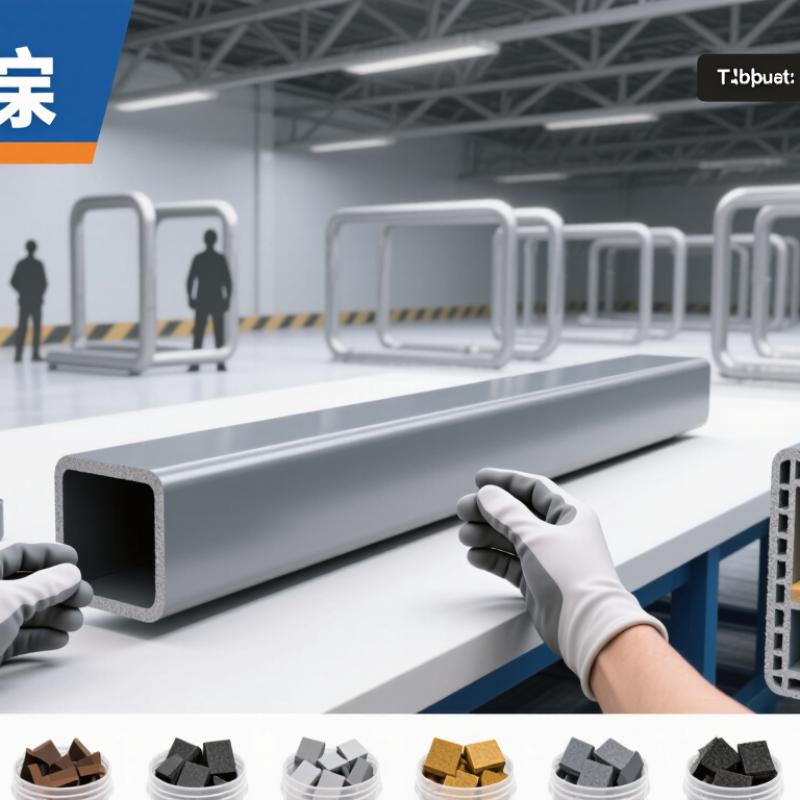
An FRP rectangular tube is a hollow structural profile made from fiber-reinforced polymer. Glass fibers provide much of its strength, while a resin binds the fibers and protects them. The rectangular shape offers flat faces for mounting brackets and broad surfaces for bolted connections. It can be lighter than a comparable metal section, though actual performance depends on its dimensions and material design. Details matter.
Many tubes are made by pultrusion. Continuous glass-fiber strands are drawn through a resin bath, then guided into a heated steel die shaped like the finished tube. The die compacts and cures the material as it moves through. Fiber mats may be added to improve strength across the profile, since lengthwise fibers alone offer less support in other directions. After curing, the continuous profile is cut to specified lengths.
Production choices affect how a tube performs. Resin type, fiber arrangement, wall thickness, and corner geometry all influence stiffness and durability. A smooth surface can hide uneven reinforcement, so buyers should review product data and inspect sample cuts when possible. It is easy to assume every FRP tube resists heat, sunlight, or chemicals equally; that assumption can be costly. Check the intended service conditions, and remember that drilling or cutting may expose fibers and require suitable finishing.

FRP rectangular tubes combine glass fibers with a polymer resin, producing a lightweight profile that resists corrosion. ACI 440.1R-15 reports tensile strengths of roughly 483–1,600 MPa and elastic moduli of 35–51 GPa for FRP reinforcing bars. These figures are useful material benchmarks, not guaranteed tube ratings.
Tube performance depends on fiber direction, wall thickness, resin, and manufacturing quality. That difference matters at a bolted corner. A tube may carry loads well along its length but need careful detailing around drilled holes, where fibers are cut. Pultruded profiles also tend to be stiffest along the fiber direction.
Check supplier test data for the actual section, not just a generic FRP specification. ASTM D638 and D790 describe tensile and flexural testing methods; request results for the finished profile. In damp or chemically exposed areas, FRP avoids many steel-corrosion concerns. But it is not immune to damage. UV exposure, heat, and impact can affect service life, so coatings and inspection may still be needed. A small oversight here can become expensive.
Industrial structures often face moisture, chemicals, vibration, and tight installation schedules. FRP rectangular tubes offer a practical alternative to conventional steel, aluminum, or timber framing in suitable applications. Their hollow shape provides useful stiffness while keeping member weight relatively low. That matters. Installers may handle shorter sections with less lifting equipment, especially in maintenance platforms or equipment guards.
Unlike unprotected steel, FRP does not rust when exposed to damp air or routine washdowns. It can also resist many corrosive environments, although performance depends on the resin and chemical exposure. No rust scale. Its low electrical conductivity can be valuable near electrical equipment, while lower thermal conductivity may reduce heat transfer through a frame. These properties can help limit maintenance interruptions, but they do not remove the need for inspection.
Design still matters. Engineers should check load capacity, deflection, connection details, temperature limits, and fire requirements for the specific tube and application. Cutting and drilling need suitable tools and dust controls. Trade-offs remain. FRP may cost more upfront than common metal sections, and its stiffness or behavior under concentrated loads can differ. A careful comparison should consider installation effort, expected exposure, and service life—not material price alone.
FRP rectangular tubes are used where steel frames face moisture, chemical splash, or frequent washdowns. At wastewater plants, they can form equipment guards, access platforms, and support frames near tanks. Their low weight helps crews position sections around pumps and pipework without heavy lifting equipment. Less weight helps. Still, connections need care.
In food-processing areas, tubes may support cable trays, instrument housings, and non-load-bearing partitions. Electrical insulation can be useful near control equipment, but it does not replace required separation or grounding practices. On coastal sites, FRP framing can resist rusting from salt-laden air better than unprotected carbon steel. Resin type and surface protection affect chemical and ultraviolet resistance. Details matter.
Rectangular profiles also suit cooling towers, utility enclosures, and modular walkways where corrosion maintenance is difficult. Designers should check span, wall thickness, connection hardware, temperature limits, and expected loads against project data. FRP can deflect more than steel, and field cuts may expose fibers unless edges are sealed as specified. A tube suited to a handrail may not work for a vibrating equipment frame. I would not assume one profile fits every site.
Selecting FRP rectangular tubes starts with the loads they must carry. Check bending direction, span, support spacing, and expected deflection, not just the tube’s outside dimensions. FRP is anisotropic, so its strength can differ along and across the fibres. Ask for tested section properties and confirm they match the proposed manufacturing method. A small sample may help assess fit, but it cannot replace structural calculations.
Next, consider the service environment. Identify chemicals, moisture, sunlight, and temperature swings the tube will face. Resin choice affects chemical resistance, while UV exposure may require a protective surface finish. Check the supplier’s temperature limits and test data for the actual conditions. Details matter. Also review connection design: drilled holes, bolts, and concentrated loads can create local stress that a general strength figure does not show.
Installation and maintenance deserve attention too. Confirm dimensional tolerances, cut-edge sealing requirements, and how the tube will be joined to metal or concrete. These practical details are easy to underestimate. A lighter section may simplify handling, yet excessive flexibility can cause vibration or alignment problems. It is tempting to select the lowest-weight option, but that choice may not suit every span. Compare documented test results with project calculations, and have a qualified engineer review the final selection.
| Selection Factor | Relevant Data or Property | What to Check for the Project | Practical Selection Guidance |
|---|---|---|---|
| Weight and handling | Typical glass-fiber-reinforced polymer (GFRP) density is about 1.8–2.0 g/cm³; carbon steel is about 7.85 g/cm³. | Compare the mass of the complete member, including fittings and connections, with the proposed steel or aluminum alternative. | Lower member weight can simplify lifting, transport, and installation, but confirm that the selected section meets strength and deflection requirements. |
| Strength and load capacity | Pultruded GFRP is anisotropic: its properties differ by direction. Strength along the reinforcing fibers is generally higher than strength across them. | Review design values for the actual profile, fiber orientation, wall thickness, load direction, support spacing, and connection details. | Use project-specific engineering calculations rather than a single generic “FRP strength” value. Check bending, shear, compression, local buckling, and combined loads as applicable. |
| Stiffness and deflection | GFRP generally has a lower elastic modulus than steel, so a lighter section may still deflect more under the same loading. | Check serviceability limits, span, support conditions, vibration, and long-term creep under sustained loads. | Select the section by both strength and allowable deflection; increasing section depth or wall thickness may improve stiffness. |
| Corrosion and chemical exposure | GFRP does not rust, but resin and reinforcement performance depend on the chemical, its concentration, temperature, and exposure duration. | Identify the specific chemicals, cleaning agents, immersion or splash conditions, operating temperature, and expected service life. | Confirm resin-system compatibility and any required surface veil or protective coating with technical data for the proposed profile. |
| Electrical and thermal properties | GFRP is generally electrically insulating and has lower thermal conductivity than metals. Conductive fillers or carbon reinforcement can change electrical behavior. | Determine whether electrical insulation, grounding, heat transfer, or thermal movement is a design requirement. | Do not assume every FRP profile is electrically non-conductive; verify the reinforcement and product specifications for the intended application. |
| Operating temperature | Temperature capability is governed largely by the resin system and the profile’s glass-transition temperature (Tg). | Check continuous and peak temperatures, temperature cycling, chemical exposure at temperature, and the specified design safety margin below Tg. | Obtain temperature-dependent mechanical data for the selected resin and profile rather than relying only on room-temperature values. |
| Fire, smoke, and heat release | FRP is combustible unless specifically formulated and tested for a required fire performance; “fire-retardant” does not mean non-combustible. | Review applicable building or process requirements, flame-spread criteria, smoke limits, and test standards for the installation location. | Specify a tested fire-performance grade when required and verify that the test evidence applies to the relevant profile and thickness. |
| UV and weather exposure | Prolonged sunlight can cause surface fading or degradation in some FRP products; protection depends on the resin, surface layer, and coating. | Assess outdoor exposure, climate, expected service life, and whether appearance or surface protection is important. | Ask for UV-weathering information and specify a suitable UV-resistant surface veil or coating where needed. |
| Connections and fabrication | FRP profiles can be cut and drilled using suitable tooling. Bolted connections require attention to bearing, edge distance, and local crushing. | Check connection loads, hole locations, washer or plate details, installation access, and compatibility of fasteners with the environment. | Design connections specifically for FRP; avoid transferring metal-profile details without checking local stresses and detailing requirements. |
| Dimensions and tolerances | Outside dimensions, wall thickness, corner radii, straightness, and cut length can vary by profile and manufacturing specification. | Confirm drawing tolerances, fit-up requirements, and whether the application depends on precise mating surfaces. | Request dimensional tolerances for the exact section and include them in procurement documents and assembly drawings. |
| Inspection and service life | FRP does not corrode like unprotected steel, but damage, delamination, UV effects, or chemical degradation may still require inspection. | Define inspection intervals and criteria for checking cracks, impact damage, exposed fibers, connection condition, and surface deterioration. | Base maintenance planning on the exposure conditions, design assumptions, and inspection guidance for the selected product. |
Note: Density figures are typical material values for comparison, not guaranteed product specifications. Mechanical, chemical, fire, and temperature performance vary by profile, resin system, reinforcement, manufacturing process, and service conditions; confirm project design values with qualified engineering documentation.
An exceptional record of quality and service for 35+ years.
© 2026 Excell Battery Co. All rights reserved.Privacy Statement