Choosing a J1772 charging station is not just a matter of buying the highest-powered unit. The right choice depends on your vehicle, electrical supply, parking setup, and daily charging routine. The International Energy Agency reported that public charging points worldwide exceeded four million in 2023, with their number growing by about 40% that year (IEA, Global EV Outlook 2024). That expansion makes home charging equipment easier to compare, but it also leaves buyers facing crowded specifications and uneven installation needs.
J1772 is a widely used AC charging connector in North America, and SAE standards define its charging interface. Before comparing models, check your vehicle’s connector requirements and maximum AC charging rate. Then look at the station’s amperage, circuit needs, cable reach, weather protection, and warranty. A long cable can reach a driveway-side port more comfortably. A hardwired unit may suit one installation, while a plug-in model may offer more flexibility. Small details matter.
A bigger number is not always better. A 48-amp station, for example, cannot deliver its full output unless the home circuit and vehicle support it. Smart scheduling and energy tracking can help, but only if you will use them. Installation costs deserve attention, too; they can change the value of an otherwise attractive J1772 charging station. Treat product claims as a starting point, not a guarantee. The best fit is often less dramatic than the spec sheet suggests.
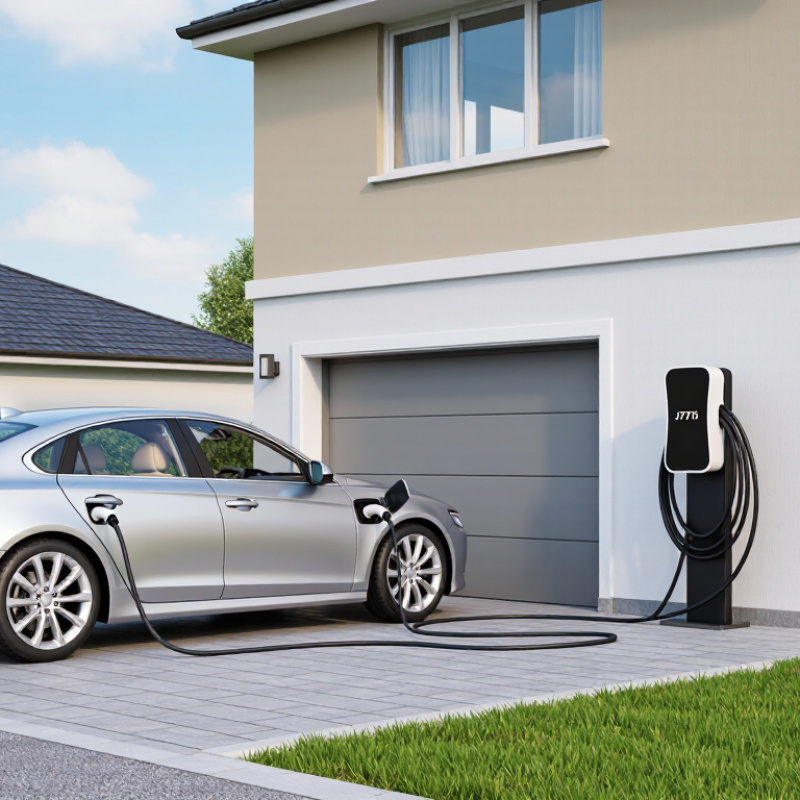
J1772 is a widely used AC charging standard in North America. It describes how a compatible vehicle and charging station connect and communicate. Level 1 charging typically uses a 120-volt supply, while Level 2 commonly uses 208 or 240 volts. The plug has five contacts: two carry AC power, one provides grounding, and two support safety and communication signals. The vehicle’s onboard charger converts AC power for the battery, so charging speed also depends on the vehicle, not just the station.
Connector details matter. A J1772 inlet accepts the matching AC plug, while some vehicles use a combined inlet with extra contacts for DC fast charging. Those extra contacts belong to a separate charging setup; a standard J1772 plug alone does not provide DC fast charging. I still find connector names confusing at a glance. Check the vehicle manual and inlet shape before choosing equipment, and confirm the station’s voltage and amperage are suitable for the vehicle and installation.
Tips: Match the connector to your vehicle’s inlet. Check the station’s rated output and your vehicle’s AC charging limit. Look for a secure latch and an undamaged cable before plugging in. Small details are easy to miss.

A J1772 charging station is useful only when it matches your vehicle’s inlet and charging limits. Many plug-in vehicles in North America use J1772 for AC charging, but check the owner’s manual before buying. Some vehicles need an adapter, and an adapter does not increase charging speed. J1772 describes the connection, not the car’s maximum charging rate.
That detail is easy to miss.
For speed, compare the station’s output with your vehicle’s onboard charger. The U.S. Department of Energy’s Alternative Fuels Data Center lists Level 2 charging equipment at roughly 3.3–19.2 kW, often adding about 10–20 miles of range per hour. Your actual rate may be lower if the car accepts less power or your home circuit has limited capacity.
For example, a vehicle capped at 7.2 kW will not charge faster on an 11.5 kW station. Check the vehicle specification and your usual overnight charging window. A large battery, cold weather, or a nearly full charge can also extend charging time.
It is easy to overbuy here. Match the equipment to your daily driving, then confirm installation requirements with a qualified electrician.
A J1772 charging station is only as useful as the electrical service supporting it. The U.S. Department of Energy’s Alternative Fuels Data Center lists Level 2 equipment outputs from about 3 to 19.2 kW. At 240 volts, a 48-amp station draws roughly 11.5 kW. That is a substantial, sustained load. Have a qualified electrician check the service rating, panel capacity, and existing loads before choosing a station. An electric dryer, oven, and heat pump may all compete for capacity during evening hours. Small details matter.
Installation conditions can change the right choice. Check the distance from the panel to the parking space, the route through walls, and exposure to rain or vehicle impact. A long conduit run or detached garage can add cost and affect placement. The electrician should calculate the home’s load, rather than relying only on empty breaker spaces; a panel can look roomy and still lack capacity. NFPA 70 treats EV charging as a continuous load, so circuit sizing must account for sustained operation and applicable local requirements. Ask for the proposed circuit rating and permit plan in writing. DOE guidance gives useful ranges, but it cannot assess your specific wiring or service. I would not assume a future panel upgrade is unnecessary just because charging works during a short test.
Comparing Safety Features, Durability, and Smart Functions
Start with protection, not a touchscreen. Look for recognized safety certification, ground-fault protection, and temperature monitoring. Check that the connector latches securely and the cable feels flexible, even in cold weather. Small details matter. A high weather-resistance rating helps outdoors, but it cannot prevent wear from repeated bending or careless storage.
Reliability deserves equal attention. J.D. Power’s 2024 U.S. Electric Vehicle Experience Public Charging Study reported that about one in five public charging visits ended without a successful charge. That finding covers public charging broadly, not J1772 units alone, but it shows why dependable hardware matters. The Federal Highway Administration’s NEVI standards set a 97% annual uptime benchmark for funded charging ports. Treat it as a useful reference, not a guarantee for home equipment.
Smart functions should solve practical problems. Scheduled charging can shift sessions to quieter hours, while energy records help track household use. Remote alerts are useful when a session stops overnight. Still, Wi-Fi can drop, and app features may change. Check the station’s manual for offline controls and firmware support. Check the cable, too. A sleek display cannot make a stiff, worn cord pleasant to handle.
How to Choose the Right J1772 Charging Station?
Matching Station Costs and Features to Your Charging Needs
A J1772 charging station should fit your driving routine, not just your vehicle’s maximum charging rate. If you usually park overnight and drive modest distances, a basic Level 2 unit may be enough. A faster, higher-amperage model may add little value if your car cannot accept its full output. Check your vehicle manual before comparing specifications. Small detail, big difference.
Look beyond the station’s purchase price. Installation can involve a new 240-volt circuit, a longer cable run, or electrical panel upgrades, and those costs vary by home. Ask a licensed electrician to assess the site and provide a written estimate. A cheaper unit may become expensive after installation. I would not assume the simplest-looking setup is the least costly.
Pay for features you will actually use. Scheduling can help shift charging to lower-rate hours, while load management may help avoid overloading a home circuit. For an outdoor parking spot, check the unit’s weather rating and cable length. App controls can be convenient, but they are not essential for everyone. It is easy to overvalue extra features; a reliable station with clear status lights may suit your habits better. Verify compatibility and installation requirements before buying.
| Station Type | Typical Output | Typical Hardware Cost (USD) | Typical Electrical Requirement | Useful Features | Best Fit |
|---|---|---|---|---|---|
| Level 1 portable EVSE | 120 V, commonly 12 A; about 1.4 kW | $150–$400 | Suitable 120 V outlet and circuit; confirm outlet condition and circuit capacity | Portable; often included with a vehicle; no dedicated 240 V installation | Low daily driving, occasional charging, or drivers who can leave a vehicle plugged in for long periods |
| Level 2, 16 A | 240 V, about 3.8 kW | $250–$600 | Typically a 20 A branch circuit | Basic home charging; plug-in or hardwired models may be available | Overnight charging with modest daily mileage or limited electrical capacity |
| Level 2, 32 A | 240 V, about 7.7 kW | $300–$700 | Typically a 40 A branch circuit | Good balance of charging speed and electrical demand; many models offer adjustable current | Most home users seeking reliable overnight charging |
| Level 2, 40 A | 240 V, about 9.6 kW | $400–$900 | Typically a 50 A branch circuit | Faster charging; consider cable reach, weather rating, and scheduling controls | Higher daily mileage or shorter periods parked at home |
| Level 2, 48 A | 240 V, about 11.5 kW | $450–$1,000 | Typically a 60 A branch circuit; commonly hardwired | High residential output; some models include energy monitoring or Wi-Fi controls | Drivers whose vehicle can accept this rate and who have adequate electrical capacity |
| Networked or load-sharing Level 2 | Often 32–48 A per charging port; output may be shared | $500–$1,500 per port | Depends on selected output and installation; load management can help limit peak demand | Usage reporting, access controls, scheduled charging, or coordinated charging across ports | Multi-vehicle homes, workplaces, or sites that need usage data and managed access |
| Commercial high-power Level 2 | Up to 80 A at 240 V, about 19.2 kW, where supported | $1,000–$3,000+ per port | An 80 A continuous charging load typically requires a 100 A circuit; verify local code and equipment specifications | Durable enclosure, network management, access controls, and options for billing or reporting | Commercial sites with long parking periods; confirm that vehicles can use the higher AC rate |
Choosing tip: J1772 stations supply AC power, and the vehicle’s onboard charger determines how quickly that power can be accepted. Hardware prices are approximate U.S. retail ranges and exclude installation, permits, and any electrical-panel upgrades. Actual costs and circuit requirements vary by equipment, site, and local code.
An exceptional record of quality and service for 35+ years.
© 2026 Excell Battery Co. All rights reserved.Privacy Statement