Choosing the right Industrial Lithium Battery is a practical engineering decision, not a simple price comparison. The correct pack must match the machine, workload, environment, and maintenance plan. A warehouse forklift, automated guided vehicle, and backup power cabinet all demand different battery characteristics.
Start with the load profile. Measure peak current, average operating time, charging frequency, and daily energy use. A battery may support the stated voltage yet fail during sudden acceleration. That detail matters. Check capacity, discharge rate, cycle life, charging speed, and usable energy together. A larger battery is not always better. It can increase weight, cost, and installation pressure.
Safety and reliability deserve close attention. Look for a well-designed battery management system, cell balancing, temperature monitoring, short-circuit protection, and clear service procedures. Thermal management is especially important in hot factories or poorly ventilated cabinets. Ask the supplier for test records, warranty conditions, traceable specifications, and technical support after installation. Claims should be measurable.
The working environment can change the decision. Dust, vibration, moisture, cold storage rooms, and continuous shifts may require a stronger enclosure and different charging strategy. Confirm connector compatibility and communication functions before purchase. Small mismatches create expensive delays.
A cheaper pack can look attractive. That assumption often fails. I would also challenge optimistic cycle-life figures, because real results depend on depth of discharge, temperature, and charging habits. Compare tested performance with your actual operating pattern. A careful selection process protects uptime, equipment value, and worker safety over the battery’s service life.
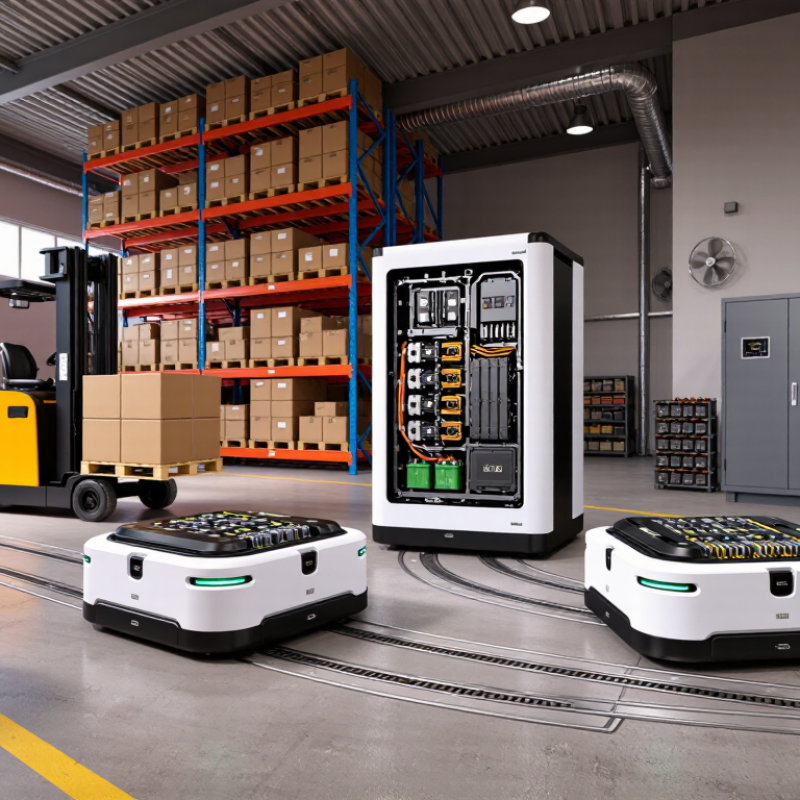
Choosing an industrial lithium battery starts with the machine, not the battery catalogue. Measure the load profile across a full shift. Record normal current, startup surges, braking peaks, and idle periods. A motor may draw modest power while running, then demand three times more during acceleration. Do not size from the nameplate alone. It can mislead.
Convert these observations into voltage, peak current, average power, and required runtime. Include conversion losses and a reserve for aging. If a 48-volt vehicle needs 120 amperes for six hours, its energy demand is not simply 34.56 kilowatt-hours. Add charger losses, traffic delays, cold starts, and accessory loads. In a refrigerated warehouse, low temperature can reduce available capacity and increase voltage sag. The battery management system should handle overcurrent, temperature limits, cell imbalance, and state-of-charge reporting. Ask for test data, not just advertised capacity.
Match the battery to its daily duty cycle. A battery used for short, intense lifts needs different power capability from one supporting steady lighting or telecom equipment. Check charging windows, connector ratings, enclosure protection, and ventilation requirements. I have seen estimates fail because operators counted scheduled hours instead of actual working minutes. That mistake is easy to repeat. Field trials under real loads reveal problems that spreadsheets miss. Leave space for imperfect data, because operating habits often change after installation.

How to Choose the Right Industrial Lithium Battery?
Compare Lithium Battery Chemistries and Cell Configurations
Industrial battery selection starts with chemistry, not marketing language. Lithium iron phosphate offers strong thermal stability, long cycle life, and lower material cost. Nickel-manganese-cobalt can provide higher energy density where space is limited. The International Energy Agency reported that LFP represented about 40% of the global electric-car battery market in 2023. That figure is not an industrial specification, but it shows the chemistry’s growing acceptance.
Cell configuration changes maintenance, cooling, and mechanical risk. Cylindrical cells are consistent and easier to automate. Prismatic cells use fewer interconnections and can simplify cabinet design. Pouch cells are lightweight, yet their swelling control requires careful compression. A 2024 U.S. Department of Energy battery technology review links thermal management, cell spacing, and battery-management accuracy with safety and service life. The best design still depends on duty cycle, ambient temperature, discharge rate, and available space. Simple answers often fail here.
Tips: Match the battery to real operating data. Record peak loads, daily cycles, charging windows, and winter temperatures. Request cycle-life results at your intended depth of discharge. Check whether testing used the same temperature and charging limits. Do not compare a 25°C laboratory result with a cold warehouse application. I would also inspect service access and replacement procedures before approving the cell format. A slightly larger pack may reduce thermal stress and improve uptime. That trade-off is easy to overlook.
| Battery Chemistry | Nominal Cell Voltage | Typical Gravimetric Energy Density | Typical Cycle Life | Thermal Stability | Typical Operating Temperature | Power Capability | Best-Fit Industrial Applications | Main Trade-Offs |
|---|---|---|---|---|---|---|---|---|
| Lithium Iron Phosphate (LFP) | Approximately 3.2 V | 90–160 Wh/kg | 2,000–5,000 cycles | High | Discharge: approximately −20°C to 60°C | Moderate to high; suitable for many high-power systems | Material-handling equipment, stationary storage, industrial vehicles, backup power, and systems prioritizing safety and service life | Lower energy density than nickel-rich chemistries; reduced low-temperature charging performance |
| Nickel Manganese Cobalt Oxide (NMC) | Approximately 3.6–3.7 V | 150–250 Wh/kg | 1,000–2,500 cycles | Moderate | Discharge: approximately −20°C to 55°C | High; available in energy-focused and power-focused designs | Electric mobility, compact industrial equipment, robotics, and applications requiring a balance of power and energy density | More sensitive to heat and overcharge than LFP; thermal management and protection are essential |
| Nickel Cobalt Aluminum Oxide (NCA) | Approximately 3.6–3.7 V | 180–280 Wh/kg | 1,000–2,000 cycles | Moderate to lower | Discharge: approximately −20°C to 55°C | High; optimized for high energy and power output | Weight-sensitive industrial vehicles, mobile equipment, and long-runtime systems with advanced battery management | Requires careful thermal control; typically less tolerant of abuse than LFP |
| Lithium Titanate (LTO) | Approximately 2.3–2.4 V | 50–90 Wh/kg | 10,000–30,000 cycles | Very high | Discharge: approximately −30°C to 55°C; charging capability can be strong at low temperatures when specifically designed for it | Very high; supports rapid charging and high-power pulses | Fast-charge equipment, grid-support systems, heavy-duty vehicles, and applications with frequent charge-discharge cycling | Low energy density, higher cost per stored watt-hour, and more cells required for a comparable pack voltage |
| Lithium Manganese Oxide (LMO) | Approximately 3.7 V | 100–160 Wh/kg | 500–1,500 cycles | Moderate to high | Discharge: approximately −20°C to 55°C | High; good short-duration power capability | Power tools, medical equipment, hybrid systems, and applications requiring high current delivery | Usually shorter cycle life; often blended with other lithium chemistries to improve durability or energy density |
| Cell Configuration | Common Form Factors | Typical Capacity Range per Cell | Mechanical Characteristics | Cooling and Thermal Management | Service and Maintenance Considerations | Space Efficiency | Recommended Industrial Use | Key Limitations |
|---|---|---|---|---|---|---|---|---|
| Cylindrical Cells | Small and large cylindrical metal-can cells | Approximately 2–100 Ah, depending on cell size and design | High mechanical strength, consistent dimensions, and good resistance to swelling | Good heat dissipation when cells are properly spaced and connected to a designed cooling system | Many individual cells and connections require robust monitoring, welding, insulation, and fault protection | Moderate; spacing and holders can increase inactive volume | Power tools, robotics, light electric vehicles, modular industrial packs, and high-volume systems | High cell count can increase assembly complexity and the number of potential interconnect points |
| Prismatic Cells | Rigid rectangular metal-can cells | Approximately 20–300 Ah, depending on application and cell design | Compact rectangular packaging with fewer cells required for a given pack capacity | Large flat surfaces can simplify thermal contact; compression and expansion control may be required | Fewer electrical connections than cylindrical designs, but individual cell replacement can be more involved | High | Industrial vehicles, energy storage cabinets, telecommunications backup, and large battery modules | Less flexible for irregular spaces; mechanical swelling management is important over long service life |
| Pouch Cells | Flexible laminated aluminum-polymer pouch | Approximately 10–300 Ah, depending on cell format and design | Very low packaging mass and flexible shape; requires rigid module support | Large surface area can support efficient cooling, but uniform thermal contact and compression are important | Requires protection against puncture, moisture, abrasion, and uncontrolled expansion; module-level repair may be difficult | Very high | Weight-sensitive equipment, compact mobile systems, aerospace-related equipment, and custom-shaped battery packs | More vulnerable to mechanical damage and swelling if the module structure is inadequate |
| Series Connection (S) | Cells or modules connected positive-to-negative | Increases pack voltage; capacity in ampere-hours remains approximately equal to one parallel string | Requires voltage balancing and monitoring across every cell or module | Uneven temperatures can cause voltage and state-of-charge imbalance | Battery management systems must monitor individual cell or module voltages | Depends on the selected cell and module format | Systems requiring higher DC bus voltage, such as industrial vehicles, inverters, and motor drives | A weak or imbalanced cell can limit the usable performance of the complete series string |
| Parallel Connection (P) | Cells or series strings connected positive-to-positive and negative-to-negative | Increases total capacity and current capability; voltage remains approximately equal to one cell or string | Requires matched cells, low-resistance busbars, and current-sharing design | Uneven resistance or temperature can cause unequal current distribution | Parallel branches need appropriate fusing, monitoring, and isolation provisions | Depends on busbar, fuse, and module layout | Long-runtime systems, high-current equipment, and applications requiring redundancy or scalable capacity | Faults can be harder to isolate because multiple branches may continue supplying current |
Selection note: The values shown are representative cell-level ranges for industrial design comparison, not guaranteed specifications. Actual performance depends on electrode formulation, cell size, charge and discharge rates, depth of discharge, temperature, cooling, compression, battery management settings, and system integration. Always verify the final design against the applicable cell and pack datasheet.
Selecting an industrial lithium battery starts with the equipment’s voltage, not the battery’s advertised capacity. Match the pack’s nominal voltage with the motor, controller, and charging system. A 48-volt system can be damaged by an unsuitable voltage range, even when its amp-hour rating looks attractive. The IEA’s Global EV Outlook 2024 reported more than 750 GWh of lithium-ion battery demand in 2023. That scale supports wider choices, but it does not remove the need for site-specific testing.
Capacity should reflect real energy demand. A 48V, 400Ah battery stores about 19.2 kWh nominally. After applying an 80% usable state-of-charge window and 90% system efficiency, roughly 13.8 kWh reaches the load. At a steady 5 kW demand, runtime approaches 2.8 hours. Actual results may fall lower during cold shifts, battery aging, or sudden acceleration. The calculation is useful, but not sacred.
Charging needs often decide the final design. Measure daily operating hours, break periods, charger current, and available electrical capacity. A battery used for three short shifts may need opportunity charging, while a single-shift vehicle may need slower overnight charging. BloombergNEF’s 2023 Battery Price Survey reported an average lithium-ion pack price of 139 dollars per kWh, reminding buyers that oversizing has a measurable cost. Temperature limits and battery-management settings also matter. A neat spreadsheet can still mislead when real duty cycles are missing.
How to Choose the Right Industrial Lithium Battery?
Safety features should match the machine’s actual working conditions. A battery needs protection against overcharging, deep discharge, short circuits, and excessive current. Thermal sensors should monitor cell temperature, not only the outer case. A strong enclosure also helps resist dust, moisture, vibration, and accidental impact. Check the stated ingress rating carefully. A laboratory rating may not reflect years of factory use.
The battery management system, or BMS, is the battery’s decision center. It should balance individual cells and record voltage, temperature, current, and fault events. Clear alarms are valuable because operators can respond before a shutdown becomes dangerous. Ask whether the BMS communicates with the machine’s control system. Without reliable data, maintenance becomes guesswork. That is a costly weakness.
Environmental limits deserve equal attention. Confirm the allowed charging temperature, discharge range, humidity, altitude, and storage period. Charging lithium batteries in freezing conditions can damage cells, even when the machine still starts. High heat can reduce service life faster than expected. Dusty areas may also require stronger sealing than the specification suggests. A useful field habit is reviewing operating logs after the first month. The original selection may look correct, yet real vibration or heat can reveal gaps. No checklist is perfect. One judgment can still be wrong. Choose a battery with documented test methods, traceable service records, and practical support from qualified technicians.
Assess safety features, battery management, and environmental limits before selecting a chemistry for industrial use.
Representative full-cycle ranges to approximately 80% remaining capacity. Actual results depend on temperature, depth of discharge, charge rate, pack design, and maintenance.
Prefer cells and packs with thermal protection, over-current protection, short-circuit protection, temperature sensors, pressure relief, and a tested enclosure.
A suitable BMS should monitor cell voltage, pack current, temperature, state of charge, and state of health while balancing cells and disconnecting the pack during unsafe conditions.
Check the manufacturer’s charge and discharge limits. Lithium-ion cells commonly require charging above 0°C, while discharge limits often extend from approximately −20°C to 55–60°C depending on chemistry and pack design.
Selecting an industrial lithium battery requires more than comparing the purchase price. An experienced supplier should provide clear datasheets, test records, cell traceability, and realistic warranty terms. Ask how each battery performs under heat, vibration, frequent charging, and heavy discharge. These details reveal manufacturing discipline.
Compatibility prevents expensive failures. Check voltage range, capacity, connector design, battery dimensions, charging limits, and communication protocols. The battery management system must work with your equipment.
Lifecycle cost also matters. Calculate expected cycle life, energy efficiency, charging time, maintenance, downtime, and replacement expenses. A cheaper battery may become costly after repeated interruptions. Always request application-specific calculations.
Test it in real operating conditions. Measure temperature, charge time, voltage stability, and usable capacity. Review safety documentation and service response times. Do not accept vague claims. One overlooked detail can stop a production line. I have seen projects focus heavily on cycle ratings while ignoring software compatibility. That mistake is easy to repeat. Suppliers should explain limitations, not only advantages, and provide evidence from comparable industrial use.
An exceptional record of quality and service for 35+ years.
© 2026 Excell Battery Co. All rights reserved.Privacy Statement