Choosing an Electric Scooter Manufacturer is not simply a price comparison. It is a reliability decision made before the first scooter reaches a customer. NACTO’s 2023 Shared Micromobility Report recorded 157 million shared micromobility trips in the United States. That scale shows real demand. It also exposes weak batteries, loose stems, and poor service quickly. Grand View Research and Fortune Business Insights report continued growth in the electric scooter market, although their estimates differ. That difference deserves attention. Market numbers are useful, but not perfect.
Horace Dediu, founder of Micromobility Industries, has described micromobility as “the future of transportation.” His view highlights a practical question: can a supplier support that future safely and consistently? A credible Electric Scooter Manufacturer should provide traceable battery cells, documented quality inspections, clear load testing, and stable spare-parts access. Ask to see factory records. Request sample units. Test braking on wet pavement, not only in a showroom.
Look closely.
The strongest evaluation combines factory experience, engineering evidence, and after-sales performance. Check whether the manufacturer follows relevant safety standards, maintains product documentation, and supports responsible battery recycling. UL certification, where applicable, can strengthen confidence, but certification alone does not guarantee every model performs equally. Reviews from fleet operators may reveal details that sales brochures hide, including charging failures and delayed replacement parts. I would also question unusually low quotes. They may reflect efficient production, or a dangerous compromise in cells, controllers, or testing. The choice is rarely perfect. Still, careful evidence can reduce avoidable risk and build a supplier relationship that survives beyond the first shipment.
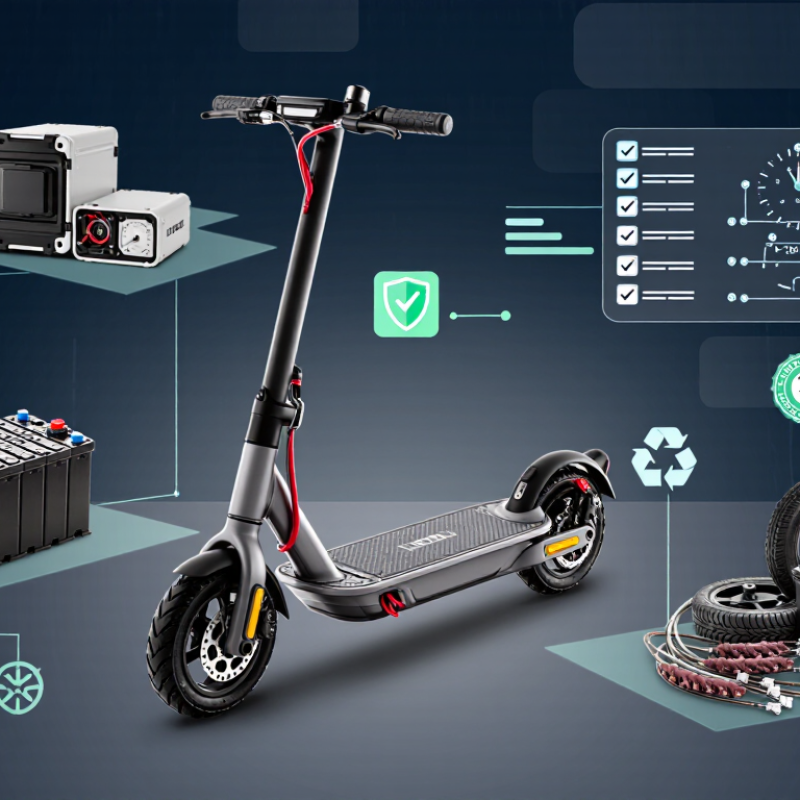
Before choosing an electric scooter manufacturer, define the rider and daily environment. A city commuter needs stable handling, efficient range, and easy charging. A rental operator may need stronger frames, replaceable parts, and simple maintenance. Delivery users often require higher load capacity and better suspension.
Write measurable requirements. Specify rider weight, expected distance, road surfaces, hill grades, storage conditions, and charging frequency. A 500-watt motor may suit moderate urban routes, but steep roads can demand different performance. Battery capacity should match real use, not only advertised range. Test samples with repeated braking, uneven pavement, and wet-weather precautions. Check battery protection, charger quality, lighting, braking distance, and water resistance. Small details matter. A loose folding latch can become a serious service issue.
Tips: Ask manufacturers for test reports, production tolerances, warranty terms, and spare-part availability. Request a sample before discussing large orders. Record range results with actual rider weight and route conditions. Do not trust one impressive demonstration. I once underestimated storage space during product planning; the design worked well, but handling boxed units became inefficient. That mistake changed how I assess packaging and after-sales support. Your target market may also value quiet operation, low maintenance, or a removable battery more than maximum speed. Review local equipment requirements and transport rules before finalizing specifications. A capable manufacturer should explain limitations clearly, accept reasonable revisions, and provide consistent quality across production batches.

How to Choose an Electric Scooter Manufacturer?
Evaluate Manufacturer Experience, Capacity, and Product Specialization
Manufacturer experience appears in practical details, not only in company brochures. Ask how long the team has produced electric scooters and which models it has developed. Experienced engineers can explain frame welding, battery placement, motor performance, and waterproofing without vague promises. Experience leaves fingerprints. Request production photos, sample inspection records, and customer feedback from comparable projects.
Capacity matters too. A supplier may build an excellent sample but struggle with a large order. Review daily output, assembly-line workers, equipment, warehouse space, and quality-control staffing. Ask about pilot-run procedures and realistic lead times. Check whether battery testing, torque checks, carton inspections, and final road tests are documented. A clear traceability system should connect each unit with materials, inspection results, and responsible staff.
Specialization reduces guesswork. Manufacturers focused on commuting scooters may understand folding mechanisms, compact frames, lighting systems, and repeated urban use better than general factories. Match their equipment and engineering skills with your intended product. Ask for samples from the same product category, not unrelated models. No supplier is flawless. That matters. A reliable manufacturer admits past defects and explains corrective actions. Review communication during sample revisions, because delayed answers often become delayed production. Independent inspections can also reveal gaps that factory reports miss. Sometimes, a smaller facility offers closer technical attention, but its capacity may limit future growth. That trade-off deserves careful checking before any purchase decision.
Choosing an electric scooter manufacturer requires more than comparing prices. Quality begins with controlled materials, consistent welding, reliable battery cells, and clear assembly records. Ask whether the factory follows recognized quality systems, such as ISO 9001, and whether each production batch receives inspection. Request sample reports, not attractive promises.
Safety testing should cover braking distance, steering strength, battery temperature, charger performance, water resistance, vibration, and repeated folding. Independent laboratory reports are more convincing than internal checklists. During factory evaluations, I have seen a polished prototype hide loose wiring and uneven brake adjustment. That experience changed my approach. Inspect production units, not only showroom samples. Testing methods can still differ, so verify the standards, equipment, and test dates.
Tips: Ask for traceable battery documents, serial-number records, and failure-rate data. Confirm that customization will not weaken safety. A larger motor, different frame, or new display may require fresh testing. Request a pilot batch before mass production. Check real units after transport, too. Small scratches can reveal weak packaging, while a warm connector may signal deeper electrical problems. Do not accept vague answers. Also, leave room for correction; even a careful evaluation can miss issues that appear after months of daily riding.
Choosing an electric scooter manufacturer requires more than comparing the lowest quotation. Pricing should show the scooter, battery, charger, packaging, testing, and shipping terms separately. Ask whether tooling, samples, software changes, and replacement parts carry extra fees. A low unit price can hide expensive development work.
Minimum order quantities affect cash flow and storage. Request a smaller pilot order before committing to mass production. In one supplier review, I learned that a 500-unit minimum became costly when demand forecasts were too optimistic. That mistake was avoidable. Also check payment stages, deposit percentages, currency, and refund conditions. Clear production terms reduce disputes.
Lead times need written milestones. Confirm sample approval, material purchasing, assembly, inspection, and final shipment dates. Ask what happens when a component is delayed. Production terms should define quality standards, battery documentation, warranty responsibilities, packaging specifications, and inspection rights. Do not accept “standard quality” without measurable criteria.
Tips: Compare at least three detailed quotations. Ask for a factory video call and recent production evidence. Test sample performance in realistic conditions, including slopes, braking, folding, and charging. Keep every promise in the contract. I would also leave a time buffer, because supplier schedules are rarely perfect.
Indicative OEM/ODM benchmarks for pricing, minimum orders, lead times, and production terms
Typical commercial terms vary by product complexity, battery specifications, certification requirements, customization level, and order volume. Unit prices are shown in USD, minimum orders in units, lead times in calendar days, and deposits as a percentage of the order value.
Choosing an electric scooter manufacturer should begin with evidence, not polished factory photos. Request samples from the same production line intended for your order. Test braking, folding joints, battery range, charger heat, and stem alignment. Record results at different rider weights and road surfaces. A quiet motor means little if the welds look uneven. Ask for serial tracking, material specifications, inspection records, and current test reports. Keep photos, measurements, and faults in one shared file.
A remote call is useful, but an on-site audit reveals more. Check incoming-material labels, torque tools, calibration dates, and final inspection benches. Speak with the quality manager, not only the sales representative. Ask how failed units are isolated and repaired. Review sample records from the last three shipments. The factory may pass a staged visit. It happens. An independent auditor can compare documents with actual stock and production flow. Revisit after corrective action, because one clean audit cannot prove lasting discipline.
Put every approval into the contract. Define battery capacity tolerance, water-resistance claims, packaging protection, spare parts, warranty response times, and acceptable defect rates. Attach approved sample photos and measured specifications. State who pays for rework, replacement freight, and inspection when goods miss agreed requirements. Payment milestones should follow verifiable production stages. Avoid vague language such as premium quality. It sounds reassuring but creates disputes. Require written notice before any component substitution. Manufacturers need flexibility, but buyers need traceability. Contracts can be too rigid, so allow documented changes with fresh sample approval.
| Verification Dimension | What to Verify | Recommended Evidence | Suggested Acceptance Target | Risk Level | Decision Guidance |
|---|---|---|---|---|---|
| Sample Specification Match | Confirm that the sample matches the agreed motor rating, battery capacity, dimensions, materials, lighting, display, charger, and accessories. | Signed specification sheet and sample inspection report | 100% of critical specifications match | High | Reject or revise the sample if any safety-related specification differs from the approved version. |
| Battery Safety and Traceability | Check cell source records, battery management system functions, protection against overcharge and over-discharge, labeling, and batch traceability. | Battery test report, production batch code, safety documentation, and inspection photos | Traceability for every battery batch; no critical safety defects | Critical | Do not place an order without documented battery controls and a corrective-action process. |
| Functional Sample Testing | Test braking, folding, acceleration, steering, lights, charging, display functions, water resistance features, and abnormal-noise behavior. | Test checklist with videos, measurements, and signed approval record | All critical functions pass before mass production | High | Use an approved golden sample as the physical reference for production inspections. |
| Durability and Road-Test Review | Evaluate frame strength, folding mechanism wear, tire performance, brake consistency, vibration, and range under representative operating conditions. | Repeated-use test log and defect record | No structural, braking, or steering defect during evaluation | High | Document test conditions because actual range and durability depend on load, speed, temperature, and terrain. |
| Factory Capability Audit | Verify production capacity, equipment, staffing, process flow, maintenance controls, storage conditions, and in-process inspection points. | On-site audit report, dated photographs, process map, and production records | All critical processes have documented controls and responsible personnel | Medium | Prefer an independent audit or an unannounced follow-up when the order value is significant. |
| Quality Management System | Assess incoming inspection, first-article approval, in-process checks, final inspection, calibration, nonconformance handling, and corrective actions. | Quality manual, inspection forms, calibration records, and corrective-action reports | Records are complete, current, and linked to production batches | Medium | A certificate alone is insufficient; verify that the system is actively used on the production line. |
| Production Capacity and Lead Time | Check monthly capacity, component availability, peak-season constraints, tooling readiness, and the lead time from order confirmation to shipment. | Capacity plan, material schedule, historical delivery records, and production calendar | Written lead-time commitment with defined delay notification rules | Medium | Avoid relying on verbal promises; separate production time from shipping and customs time. |
| Pre-Shipment Inspection | Inspect appearance, dimensions, accessories, charging, brakes, folding, labels, packaging, and random carton quantities before shipment. | Independent inspection report with sampling plan and defect photos | Zero critical defects; major and minor defects within agreed limits | High | Do not release the final payment until inspection results meet the contract requirements. |
| Contract Specification Control | Define the approved model, revision number, bill of materials, packaging, labeling, testing method, and change-approval procedure. | Signed purchase agreement and controlled technical annex | One unambiguous specification set signed by both parties | High | Treat undocumented substitutions or design changes as nonconformities requiring written approval. |
| Warranty and Corrective Action | Clarify warranty duration, covered components, response time, spare-parts availability, repair responsibility, and replacement procedures. | Warranty clause, service workflow, spare-parts list, and escalation contacts | Written response and corrective-action deadlines | Medium | Specify who pays for replacement parts, labor, transport, and verified product recalls. |
| Payment and Shipment Protection | Link payment milestones to sample approval, production completion, inspection results, and shipping documents. | Payment schedule, inspection-release condition, shipping terms, and document checklist | Final payment conditional on passing inspection and complete documentation | High | Use clearly defined remedies for late delivery, failed inspection, missing documents, or unauthorized substitutions. |
| Overall Supplier Decision | Combine sample performance, audit findings, contract readiness, communication quality, and corrective-action capability. | Weighted supplier evaluation scorecard | Minimum 80/100 with no unresolved critical finding | Decision Gate | Approve only when evidence is consistent across samples, audits, and contract commitments. |
An exceptional record of quality and service for 35+ years.
© 2026 Excell Battery Co. All rights reserved.Privacy Statement