Choosing a Mbbr System For Wastewater Treatment starts with the wastewater, not the equipment brochure. A moving bed biofilm reactor uses small carriers that provide surfaces for microorganisms to grow. Air or mechanical mixing keeps those carriers moving through the treatment tank. The process can suit municipal and industrial applications, but performance depends on more than media type. Small details matter.
Begin by documenting average and peak flow, influent strength, temperature, and the required effluent quality. These figures help determine tank volume, media quantity, aeration needs, and screening requirements. Ask suppliers to explain their design assumptions, including expected loading and media fill fraction. A high advertised surface area alone does not prove a system will meet your needs. No single number settles it.
Compare the proposed system with site conditions. Check available footprint, existing tanks, power supply, downstream treatment, and access for maintenance. Review how the design handles peak loads, retains carriers with screens, and supplies enough oxygen without excessive energy use. Request operating data from comparable installations, not just ideal design estimates. Where uncertainty remains, independent engineering review or pilot testing can reduce risk. That can feel slow, but replacing an undersized blower or unsuitable screen is worse. Trade-offs remain. A careful selection balances treatment goals, reliability, operating costs, and the skills of the people who will run the plant.
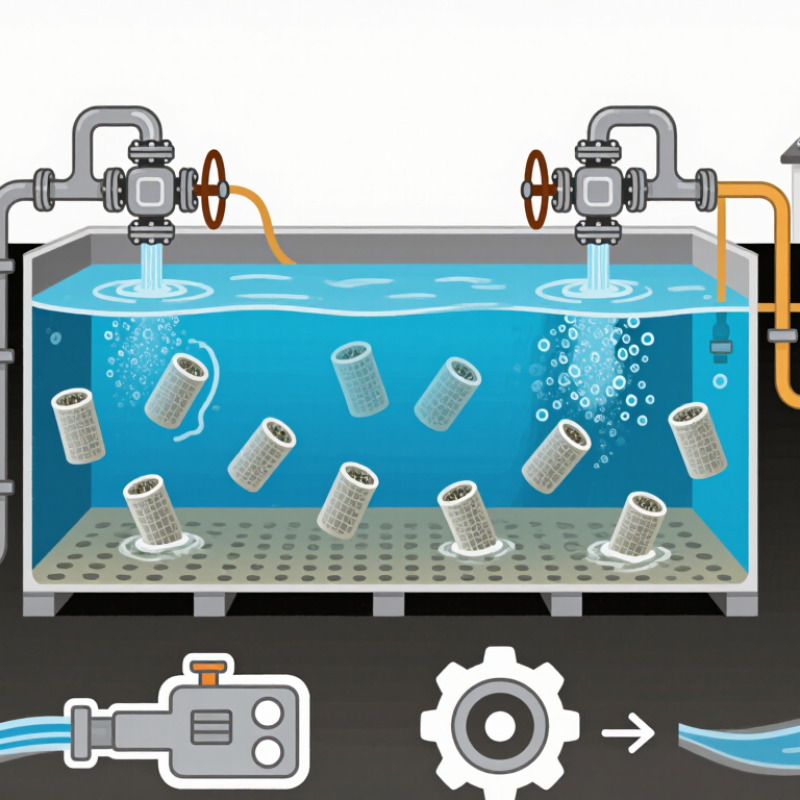
An MBBR system treats wastewater by growing microorganisms on small plastic carriers suspended inside a tank. Incoming water usually passes through screening first, where rags and larger debris are removed. Air diffusers or mixers keep the carriers moving and supply oxygen. A thin biofilm forms on their surfaces. These microorganisms consume biodegradable pollutants and, when conditions allow, convert ammonia into nitrate. The carriers stay in the tank while treated water flows onward. Simple in principle. Not effortless in practice.
Choosing a system means matching tank volume, carrier fill, and aeration to actual wastewater flow and pollutant levels. A food-processing facility, for example, may see sharp organic-load changes between shifts. A municipal plant may need steady ammonia removal through colder months. Both require site-specific design. Too little oxygen can limit treatment; too much airflow wastes energy and may disrupt the process. Downstream settling or filtration may still be needed to remove suspended solids. Check influent data, temperature swings, existing tank dimensions, and discharge targets before selecting equipment. A single lab sample can be misleading. Repeated testing gives a more useful picture, though operating conditions will still change.

Before selecting an MBBR system, define the treatment result it must achieve. Identify required reductions in organic load, suspended solids, or ammonia, and set measurable effluent targets. A small food-processing plant may face sharp washdown peaks, while municipal flows often vary by hour. That matters. Design around measured average and peak flows, not a single convenient sample.
Collect influent data across operating conditions, including temperature, pH, and pollutant concentrations. Check seasonal changes and any planned production increases. MBBR carriers provide surface area for biofilm growth, but their performance depends on suitable loading, aeration, and screening. Existing basins may be reusable, yet their depth, shape, and mixing pattern can limit practical capacity. Check power supply, access for maintenance, and space for screens and blowers. Operators matter.
Walk the site with the people who run the plant. Ask where solids collect, how often screens need attention, and whether backup equipment is available. A spreadsheet can make uncertain data look exact; it is worth noting gaps rather than hiding them. Confirm key assumptions with additional sampling or a treatability assessment before sizing equipment. That step may feel slow, but it can prevent a system from being sized for conditions the site rarely sees.
Compare representative domestic wastewater influent ranges with example secondary-treatment planning values when setting initial MBBR goals. Actual influent concentrations and permitted effluent limits vary by location and facility; confirm them with site sampling and applicable regulations. Ammonia targets are site- and permit-specific.
A reliable MBBR design starts with measured wastewater flows and loads, not the tank volume alone. Record average and peak flow, daily BOD or COD, ammonia, temperature, and solids. A small equalization tank can soften sharp flow swings, but it cannot fix an undersized biological process. Size the reactor against expected loading and required effluent limits, then check hydraulic retention time at peak flow.
Process design also depends on carrier media and oxygen transfer. The media’s protected surface area supports biofilm growth, but filling the tank too heavily can restrict movement and mixing. Confirm the proposed fill fraction with the supplier’s design data, and verify that screens retain carriers without clogging. Aeration must keep carriers moving while meeting oxygen demand; watch for dead zones near corners and under diffuser grids. Leave room for maintenance access. A design that works on paper may still need adjustment after startup, especially when influent quality changes seasonally.
Tips: Ask for the assumptions behind every capacity figure. Compare peak-day loading, not just annual averages. If data are uncertain, sample over time or run a pilot test. It may feel slower, but guessing can be costly.
Choosing an MBBR system means matching carrier media, aeration, and tank geometry to the actual wastewater. The US EPA’s Moving Bed Biofilm Reactor fact sheet reports carrier fill ratios commonly around 40–70% of reactor volume. More media is not automatically better: carriers need room to move, and screens must retain them without trapping debris. Check protected surface area, carrier density, and resistance to abrasion against the supplier’s test data. Then confirm performance with site-specific wastewater, not a catalogue example.
Aeration must supply oxygen and keep carriers circulating. Watch the water surface: dead zones, quiet corners, or carriers piling against a screen can signal poor distribution. Design checks should account for peak oxygen demand, diffuser fouling, and the energy cost of continuous mixing. EPA’s Nutrient Control Design Manual notes that nitrification slows as temperatures fall, so cold-weather oxygen and treatment margins deserve attention. Small changes matter.
Layout affects access as much as biology. Compare single-stage and staged tanks, screen locations, bypass provisions, and space for diffuser maintenance. A compact arrangement may fit a tight site but complicate cleaning; that trade-off is easy to underestimate. Ask engineers to show carrier movement and airflow under minimum and peak loads. A simple pilot or mixing test can reveal problems before concrete is poured. I would still treat generic sizing ranges as a starting point, not a promise.
How to Choose the Best MBBR System for Wastewater Treatment
Evaluate Operating Needs, Costs, and Compliance
Choose an MBBR system around the wastewater your plant actually receives, not just its average flow. Review peak flows, BOD, COD, ammonia, temperature, and suspended solids. A morning sample may miss a washdown surge or a weekend lull. Use operating records across seasons when possible. These details affect tank volume, media fill, and aeration needs.
Compare more than the purchase price. Blower electricity, screen cleaning, media retention, sludge handling, and operator time all shape long-term cost. Ask suppliers for energy estimates tied to your actual load, and check what assumptions they used. A spreadsheet can make costs look precise when influent quality is not. That matters.
For compliance, compare expected effluent quality with your discharge permit and required monitoring limits. Confirm the design can handle peak loading, and plan accessible sampling points. Request performance data from comparable wastewater conditions, not just ideal test results. I’d be cautious about promises of guaranteed compliance; real plants vary, sometimes in ways the design model misses. Commissioning data and routine lab tests help reveal those gaps early.
| Evaluation Factor | Municipal Secondary-Treatment Upgrade | Industrial Wastewater with Variable or High Organic Loads | Nitrification or Permit-Driven Upgrade |
|---|---|---|---|
| Best suited to | Increasing biological capacity at an existing plant, especially where adding conventional aeration-basin volume is difficult. | Wastewater with changing flow or biodegradable organic loads, provided toxic or inhibitory compounds are identified and managed. | Improving ammonia removal or adding biological treatment capacity where discharge limits require more consistent performance. |
| Key design inputs | Average and peak flow, influent BOD5/COD, temperature, existing tank dimensions, and downstream clarification capacity. | Flow and load profiles, COD fractionation, pH, temperature, salinity, toxicity, and the effect of production cycles or cleaning discharges. | Influent ammonia, required effluent ammonia, minimum wastewater temperature, alkalinity, dissolved oxygen, and available contact time. |
| Media fill and retention | Media fill is commonly selected within roughly 30–60% of reactor volume, subject to media geometry, mixing, screen design, and supplier limits. | Fill fraction is established by the required treatment capacity and hydraulic mixing checks; higher fill is not automatically better. | Reactor sizing must provide sufficient protected biofilm area and contact time at the coldest expected operating conditions. |
| Aeration and mixing | Provide oxygen for carbon removal and enough mixing to keep carriers moving throughout the reactor; verify blower and diffuser capacity. | Design for peak oxygen demand and load swings. Equalization, staged treatment, or load control may be needed for stable operation. | Maintain oxygen and alkalinity for nitrification. Nitrification commonly requires more oxygen and is more temperature-sensitive than carbon removal. |
| Solids separation | Confirm that the existing clarifier or downstream separation process can handle the additional suspended solids and sloughed biofilm. | Allow for variable solids production and consider pretreatment where oil, grit, or high suspended solids could disrupt operation. | Include reliable downstream solids capture; an MBBR reactor alone does not remove suspended solids from the final effluent. |
| Capital cost considerations | Often attractive for a retrofit when existing tanks can be reused; costs include carriers, retention screens, aeration upgrades, and installation. | Cost depends on equalization, pretreatment, corrosion-resistant materials, redundancy, and the range of influent conditions to be covered. | May require additional reactor volume, aeration capacity, alkalinity management, and polishing or filtration to meet the discharge permit. |
| Operating cost drivers | Blower electricity, diffuser maintenance, screen cleaning, carrier loss prevention, and routine effluent monitoring. | Energy use, pH or nutrient adjustment, pretreatment, process monitoring, and management of variable production loads. | Aeration energy, alkalinity addition where needed, temperature-related capacity, and more frequent ammonia monitoring. |
| Compliance checks | Compare expected performance with the site permit for BOD5, TSS, ammonia, and any applicable nutrient limits. | Check permit limits and local pretreatment requirements for parameters such as pH, COD/BOD, TSS, oil and grease, and specific regulated pollutants. | Use permit-specific ammonia and nitrogen limits, sampling requirements, seasonal conditions, and any required effluent polishing as design criteria. |
| Main risks to evaluate | Insufficient clarifier capacity, inadequate aeration, poor carrier movement, or hydraulic short-circuiting. | Shock loads, toxic compounds, pH excursions, temperature changes, and inadequate equalization or pretreatment. | Low temperatures, insufficient alkalinity or oxygen, inadequate biofilm contact time, and relying on biological treatment without solids polishing. |
| Useful selection documents | Recent flow and laboratory data, tank drawings, blower and clarifier capacity checks, and a process performance guarantee tied to defined influent conditions. | Representative sampling across production cycles, treatability testing where uncertainty is high, chemical inventory, and a load-variation assessment. | Seasonal ammonia and temperature data, alkalinity measurements, permit conditions, process calculations, and a commissioning and monitoring plan. |
Planning note: Media fill ranges are preliminary screening guidance, not universal design limits. Final sizing and expected effluent quality depend on wastewater characteristics, temperature, media properties, reactor hydraulics, aeration, downstream solids separation, and site-specific permit requirements. Obtain project-specific process calculations and cost estimates before equipment selection.
An exceptional record of quality and service for 35+ years.
© 2026 Excell Battery Co. All rights reserved.Privacy Statement